

Fostering Diversity & Inclusion
CrossCurrents Library
CrossCurrents is an electronic publication that offers articles on a wide range of topics related to teaching and learning in higher education. Through engaging content that encourages exploration and reflection on best practices, innovative pedagogies, and emerging trends in higher education, we try to help college teachers successfully navigate the challenges they face in today’s complex classroom.
Featured Collections
Topics

For better or worse, college classrooms are now AI-rich environments. According to a survey of nearly 4,000 associate and bachelor’s degree students, 57% reported using AI daily or weekly in some capacity to complete their coursework, while only 13% reported never using it for any reason. Such widespread use of AI for learning support has introduced new anxieties among instructors and students.

Introduction While college instructors often seek to impart knowledge, they also hold the capacity to inspire lifelong learning, critical thinking, responsiveness, and reflection. Dialogic classrooms are one way to enhance these skills while increasing student content knowledge retention (Resnick et al., 2018). Dialogic learning is active and reciprocal learning between students and their instructor to examine perspectives and varied understandings

Over the past two decades, digital technologies have become widely embedded in almost every level of education, with higher education experiencing particularly extensive adoption of online platforms and data-driven tools.

Using Productive Struggle and Productive Failure Purposefully: Optimizing Challenge in the Classroom
Introduction The words “struggle” and “failure” often carry negative connotations and can be difficult topics for both instructors and students to discuss (Rawle et al., 2026). Faculty work hard to ensure learners are successful, and students invest significant time, effort, and resources to achieve the academic goals they have set for themselves. However, a growing body of research suggests that

Office hours are one of the most common ways for students to receive help from their instructors outside designated class time. Although teaching and learning research suggests a positive correlation between attending office hours and increased academic performance, many learners underutilize this resource.

“Check the syllabus” is a common refrain among college instructors, highlighting the centrality of this document in the higher education classroom. Course syllabi provide students with first impressions of the classes they take by outlining each course’s policies and procedures. While they offer a wealth of information, traditional syllabi are often dense, intimidating, and uninspiring.
HyFlex (hybrid flexible) courses have emerged as one way to meet modern learners’ need for personalization and adaptability. HyFlex classes combine face-to-face and online learning by simultaneously offering in-person classroom instruction and virtual synchronous and asynchronous meetings.
Successful learning is a collaborative process that requires both instructors and students to engage in knowledge creation. Despite this shared responsibility, feedback on coursework is often one-sided, privileging the instructor as the sole arbiter of student achievement. This method creates an inequitable power dynamic, positioning learners as passive recipients of knowledge.
College students across the globe experience high levels of stress, anxiety, and depression that may negatively impact their participation and learning in academic environments. One evidence-based way to address these challenges is to foster a strong sense of classroom community. Multiple studies suggest that when students feel respected, psychologically safe, and connected to their instructors and peers, they are more motivated and engaged in their academic pursuits, enhancing their learning outcomes. This post explores research-supported teaching strategies that help instructors intentionally cultivate classroom communities that strengthen student engagement.
Storytelling is a fundamental component of the human experience. For thousands of years, humans have used narrative to convey their understanding of the world around them, both verbally and in writing. As Dahlstrom (2014) explains, a traditional narrative structure with a clear beginning, middle, and end is far more engaging and emotionally charged than only listening to data. Telling stories is not only a useful way to present information, but also an important means of connecting with others by developing empathy through shared understanding.

Creating equitable classrooms that support neurodiverse students is a growing priority in higher education. Historically, neurodiversity has been used to describe cognitive differences that are often represented in conditions like autism spectrum disorder (ASD), obsessive compulsive disorder (OCD), dyslexia, and attention deficit hyperactivity disorder (ADHD). However, neurodiversity now functions much as a nonmedical umbrella term to describe any naturally occurring variation in neurodevelopmental or cognitive processing.
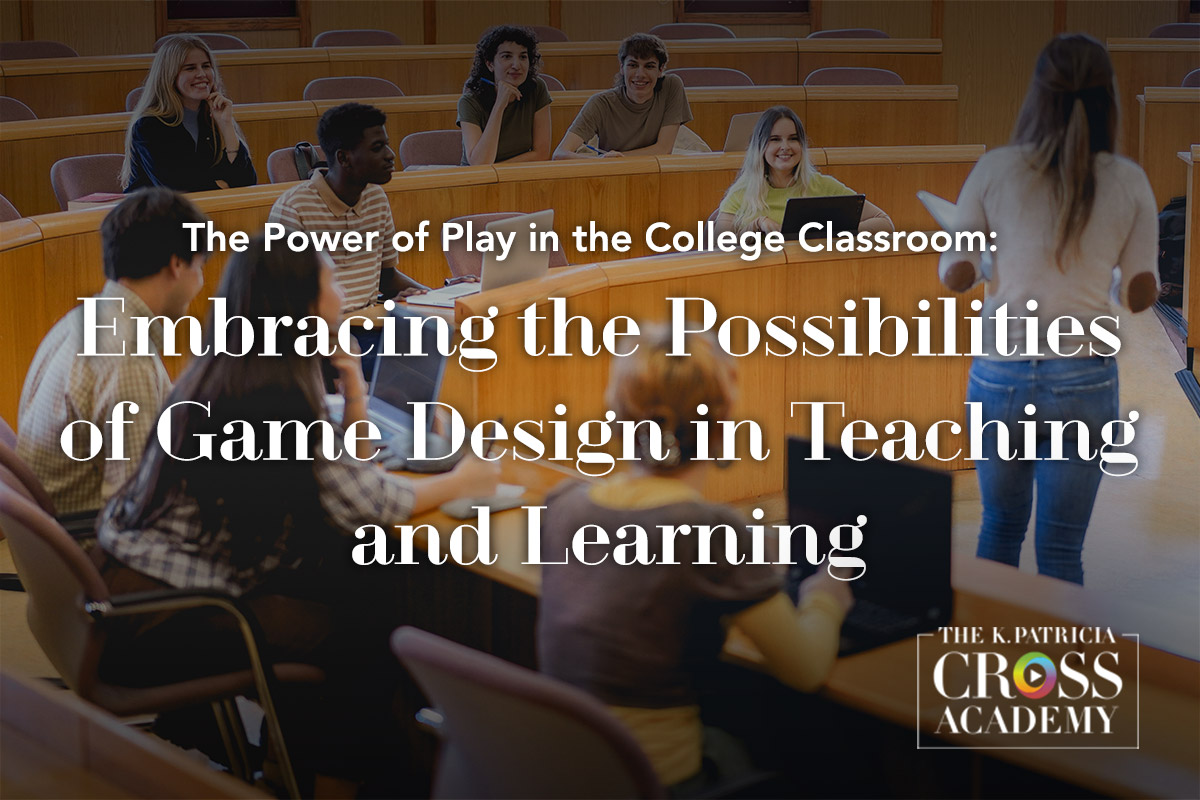
Teaching in the 21st century seems harder than ever. Because networked technologies are ubiquitous, many instructors must compete with computer games, cell phone apps, or social media for students’ time and attention. While digital systems enable learning that is flexible and convenient, they don’t always align with more traditional approaches to teaching. Consequently, educators are challenged with developing a pedagogy that meets the needs of learners who have come to expect instruction that is immediate, entertaining, and personalized.
